
Build a floor bed yourself: plan with drawings
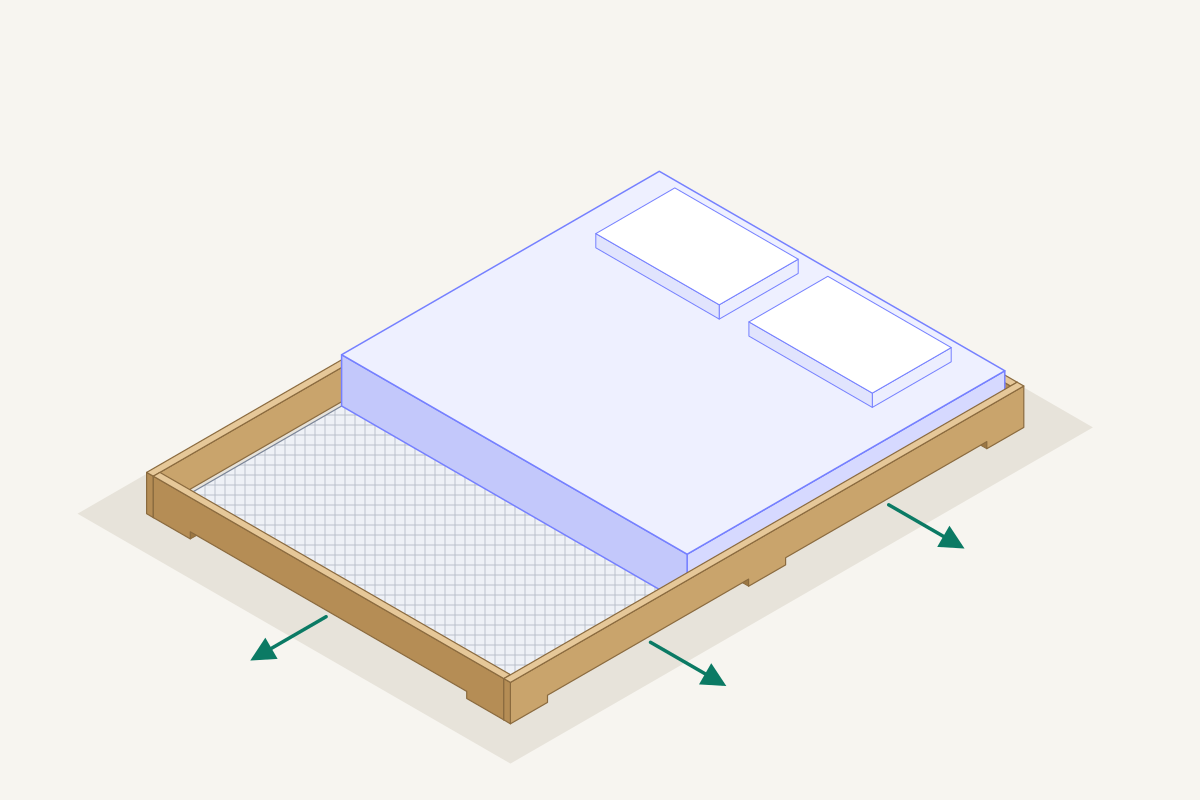
A wooden frame with air slots and Matnext Airflow inside instead of slats: this way the mattress gets air even right on the floor.
Building a floor bed: the essentials first
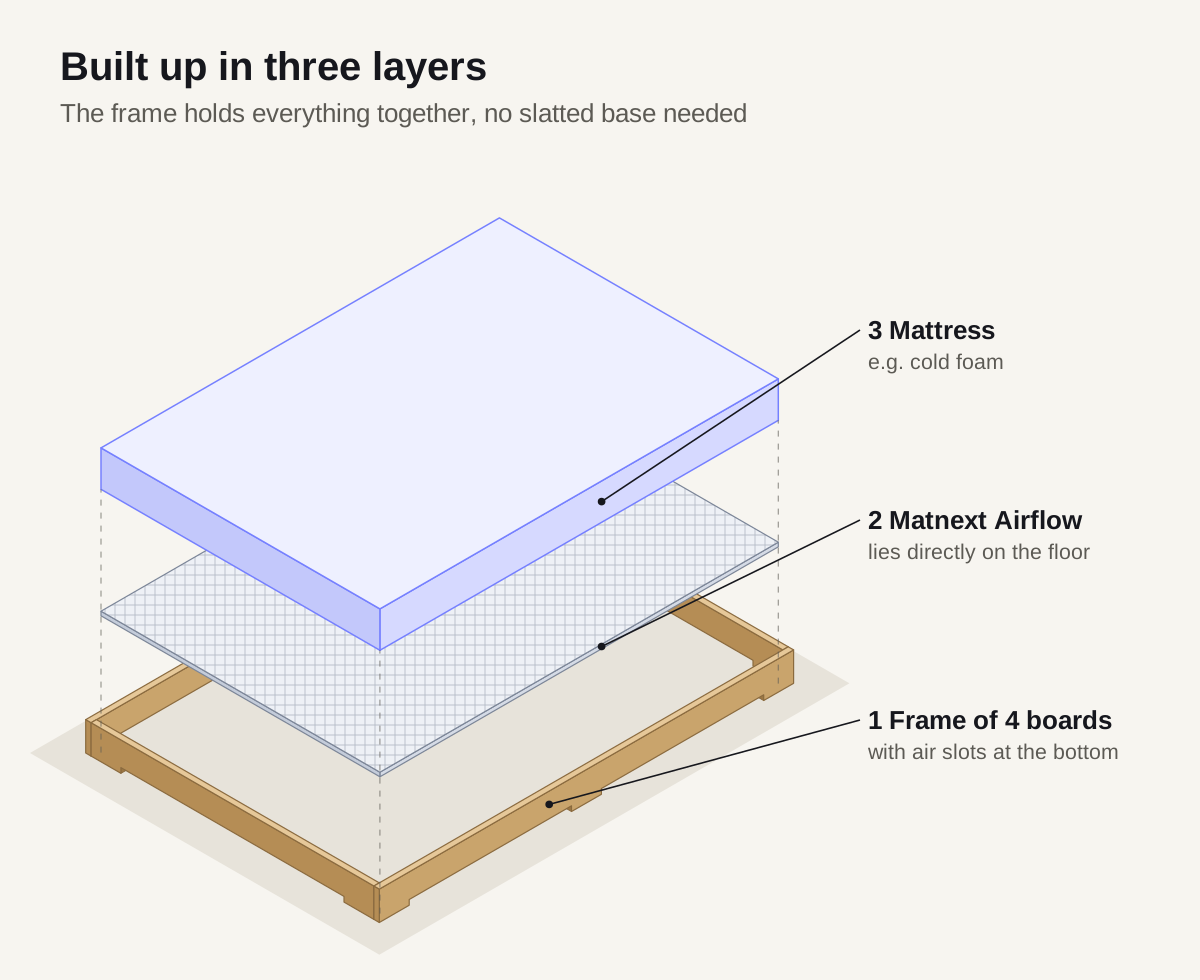
In short: you build a frame from four boards and stand it on the floor. Inside the frame you lay Matnext Airflow, and the mattress goes on top. You do not need a slatted base.
Four simple steps:
- Cut four boards to length, many DIY stores will do this for you.
- Saw a shallow slot into the bottom of each board so air can get through.
- Screw the boards together at the corners to form a rectangle.
- Lay Matnext Airflow in the frame, put the mattress on top, done.
A floor bed is a bed on the floor: the mattress lies almost directly on the floor, without a bed frame on legs and without slats. It looks calm and tidy, fits under sloping ceilings and is popular in children's rooms because children can climb in and out on their own. You need no experience with wood joints: just straight cuts, a few screws, a jigsaw and a cordless drill.
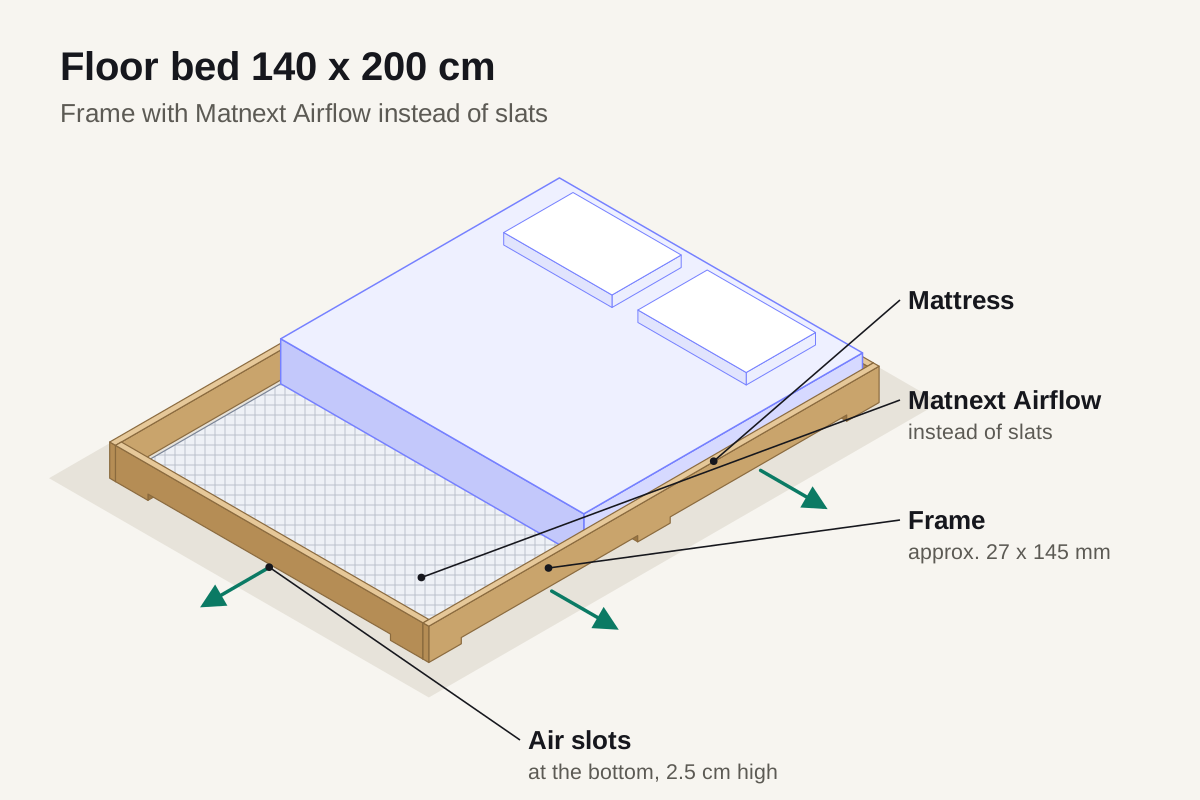
The catch with any mattress on the floor is moisture on the underside and, in the worst case, mould. That is why you do not build a slatted base here, only a frame as a surround. The bottom of the bed is the 3D mesh underlay Matnext Airflow: it lies inside the frame directly on the floor, and the mattress lies on it. Slots at the bottom of the frame let the air from the underlay escape sideways. You will find everything explained with dimensions and drawings below.
- Only a frame of 4 boards, no slatted base
- Matnext Airflow lies directly on the floor and replaces the slats
- Air slots at the bottom of the frame let moisture escape sideways
- Sizes for mattresses from 90 to 200 cm wide
- Tools: jigsaw and cordless drill
Why does a mattress on the floor get damp?
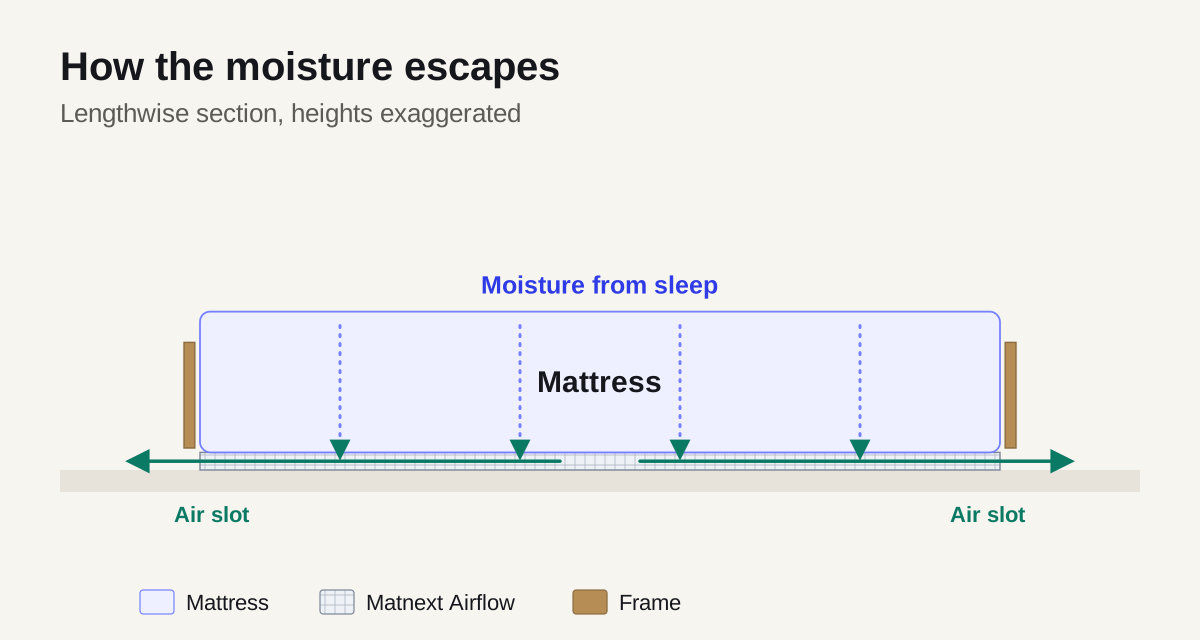
During sleep the body gives off heat and moisture. Part of it travels down through the mattress. In a classic bed this moisture can escape under the mattress. If the mattress lies flat on the floor, that route is missing.
On top of that, the floor is often cooler than the air in the room. When warm, moist air from the mattress meets the cooler surface below, it can condense there. If the underside stays damp for long, mildew stains and mould develop over time. You can read more in our guides Put the mattress on the floor? and Prevent mould on the mattress.
Floor bed without slats: Matnext Airflow replaces them
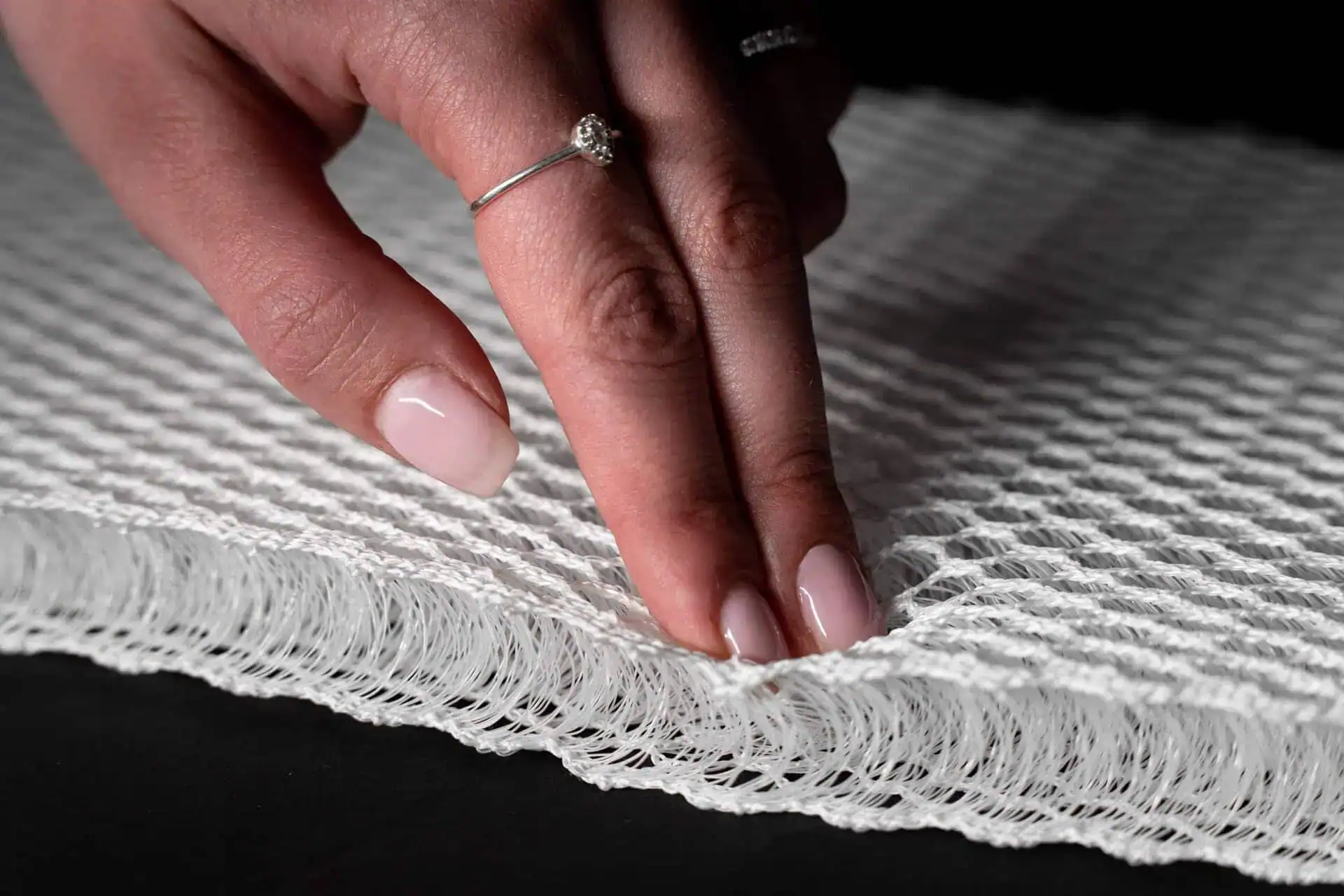
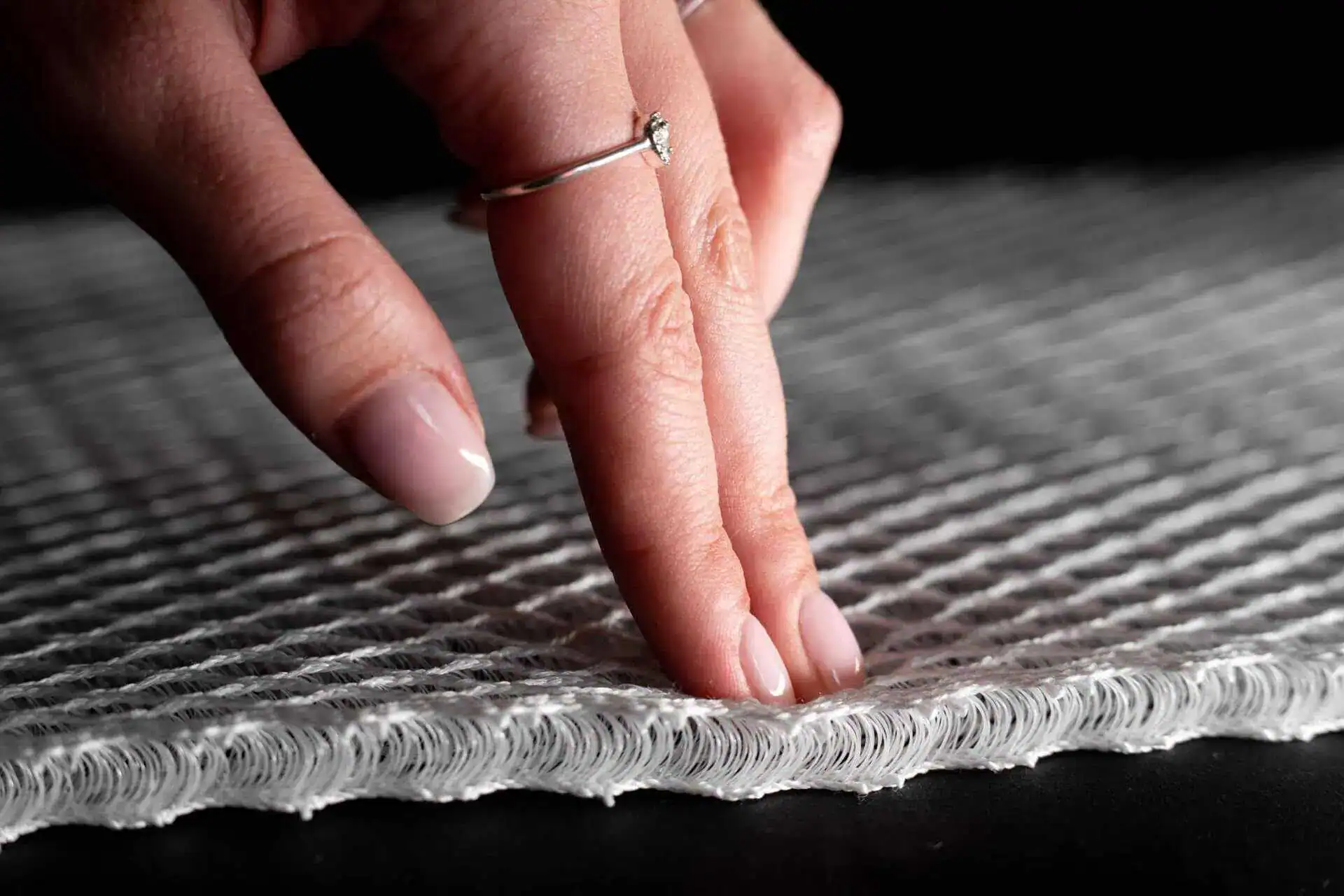
Matnext Airflow is a three-dimensional polymer mesh. It keeps the mattress at a distance from the floor, and air can flow through it in every direction. For this to work, the underlay needs a flat, continuous surface. On a slatted base it would press into the gaps between the slats. That is why in this plan it lies directly on the floor, and the frame keeps underlay and mattress in place.
The build plan at a glance
The floor bed consists of three layers: the frame of four boards, Matnext Airflow inside the frame on the floor, and the mattress. The boards stand on edge. Along their bottom edge, slots 2.5 cm high are cut out, leaving feet only at the ends and in the middle of the long sides. The corners are screwed, you do not need glue. This way the bed can be taken apart again when you move.
The dimensions for 140 x 200 cm
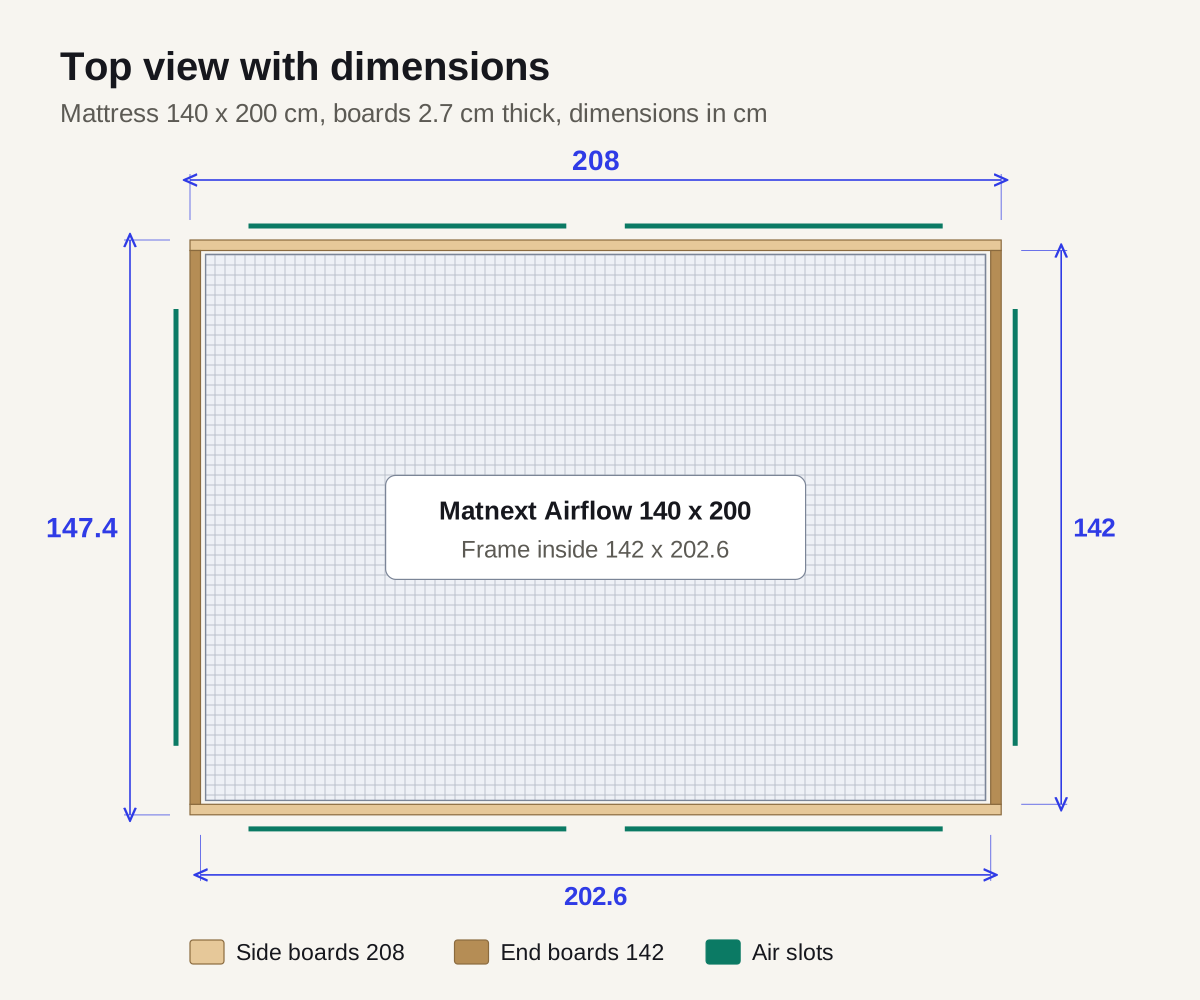
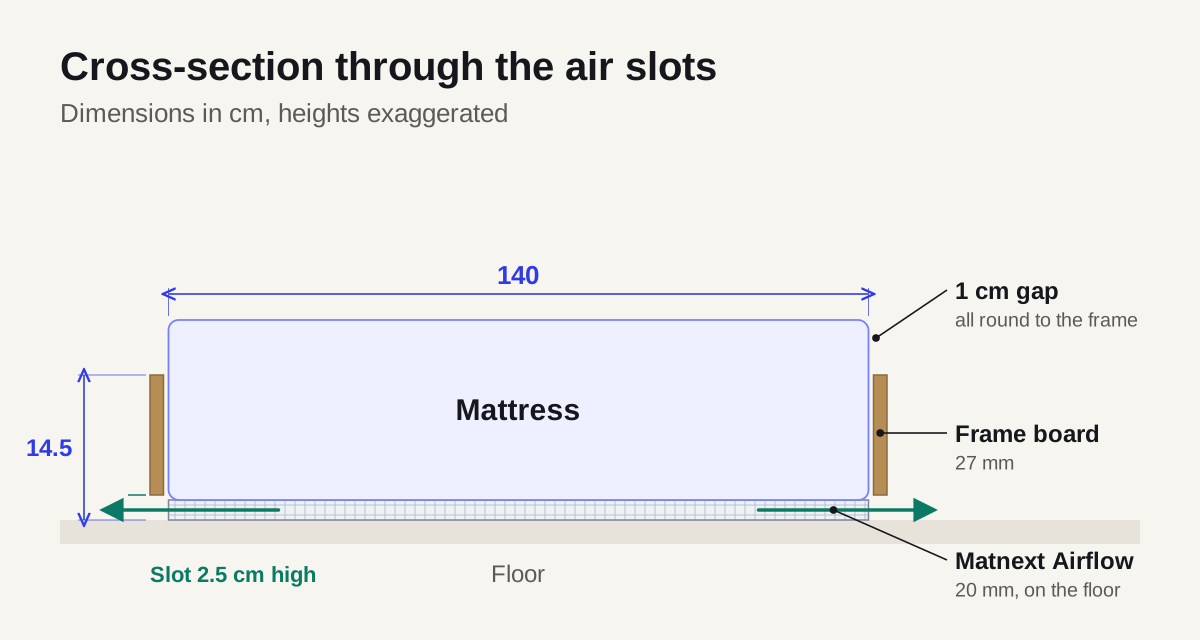
The side boards run through on the outside and are 208 cm long. The end boards sit butted between them and are 142 cm long. With a board thickness of 2.7 cm this gives 142 x 202.6 cm inside and 147.4 x 208 cm outside. The mattress then has about 1 cm of clearance to the frame all round, and Matnext Airflow lies underneath in the same size as the mattress.
The air slots
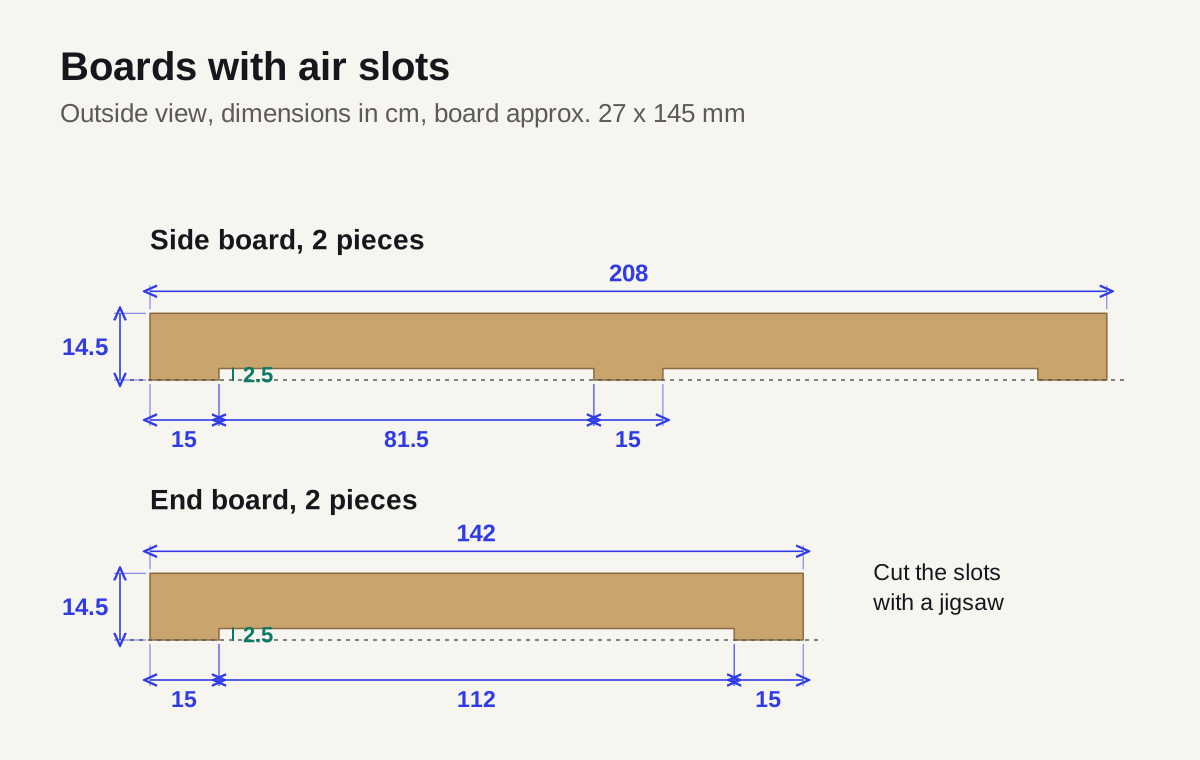
Each board is 14.5 cm high. Along almost its whole length you saw a strip of 2.5 cm off the bottom. What remains are feet 15 cm long: on the side boards at both ends and in the middle, on the end boards at both ends. The slots are slightly higher than the 20 mm underlay. This leaves its edge exposed on all four sides, and the air can get out.
Material list for a floor bed 140 x 200 cm
| Part | Quantity | Size | Note |
|---|---|---|---|
| Side boards, laminated or planed board (spruce or pine) | 2 | approx. 27 x 145 mm, 208 cm long | run through on the outside |
| End boards, same wood | 2 | approx. 27 x 145 mm, 142 cm long | sit butted between them |
| Countersunk wood screws | 12 | 5 x 70 mm | 3 per corner |
| Angle brackets with matching short screws | 4 | approx. 40 x 40 mm | inside each corner at the top |
| Self-adhesive felt pads | 10 | to suit the board thickness | under each foot |
| Sandpaper | 1 sheet each | grit 120 and 180 | for edges and slots |
| Wood oil (optional) | as needed | drying time as per manufacturer | |
| Matnext Airflow PLUS 20 mm | 1 | 140 x 200 cm | same size as the mattress |
Boards of this size are sold in DIY stores as laminated panels or planed boards, and many stores cut them to size on request. If your wood differs slightly, for example 28 instead of 27 mm, only the outside dimensions change minimally. What matters is the inside size: mattress width plus 2 cm and mattress length plus 2 to 3 cm.
Tools
- Jigsaw with a wood blade
- Cordless drill with a matching bit
- Wood drill bits 3 mm and 5 mm, plus a countersink
- Folding rule or tape measure, pencil and try square
- Sanding block or orbital sander
- Two clamps and a straight batten as a saw guide
Floor bed 90x200, 120x200, 140x200, 160x200, 180x200: the dimensions
The calculation is the same for every size: end board equals mattress width plus 2 cm, side board equals mattress length plus 8 cm. For a mattress length of 200 cm the side boards are therefore always 208 cm long.
| Mattress | Side boards (2 pieces) | End boards (2 pieces) | Feet per end board | Matnext Airflow |
|---|---|---|---|---|
| 90 x 200 cm | 208 cm | 92 cm | 2 | 90 x 200 cm |
| 100 x 200 cm | 208 cm | 102 cm | 2 | 100 x 200 cm |
| 120 x 200 cm | 208 cm | 122 cm | 2 | 120 x 200 cm |
| 140 x 200 cm | 208 cm | 142 cm | 2 | 140 x 200 cm |
| 160 x 200 cm | 208 cm | 162 cm | 3 | 160 x 200 cm |
| 180 x 200 cm | 208 cm | 182 cm | 3 | 180 x 200 cm |
| 200 x 200 cm | 208 cm | 202 cm | 3 | 200 x 200 cm |
From a width of 160 cm, the end boards also get a foot in the middle, just like the side boards. For mattresses 210 cm long use side boards of 218 cm, for 220 cm long 228 cm. If your mattress does not fit any standard size, you can order Matnext Airflow as a custom size cut to the centimetre.
Building instructions in 7 steps
Step 1: Cut the boards
Cut two side boards to 208 cm and two end boards to 142 cm, or have them cut at the DIY store. Use the try square to check that all ends are square. Ends that are not square leave open joints at the corners later.
Step 2: Mark and saw out the air slots
On each board, draw a line 2.5 cm above the bottom edge. Mark the feet, each 15 cm long: on the side boards at both ends and in the middle (from 96.5 to 111.5 cm), on the end boards at both ends. First saw the short vertical cuts at the edges of the feet, then the long cut along the line. A straight batten clamped in place helps to guide the jigsaw straight.
Step 3: Sand the edges and slots
Sand all edges and the cut edges of the slots slightly round, first with grit 120, then with 180. This leaves no splinters for bedding to catch on. In a child's room this is especially important.
Step 4: Screw the corners together
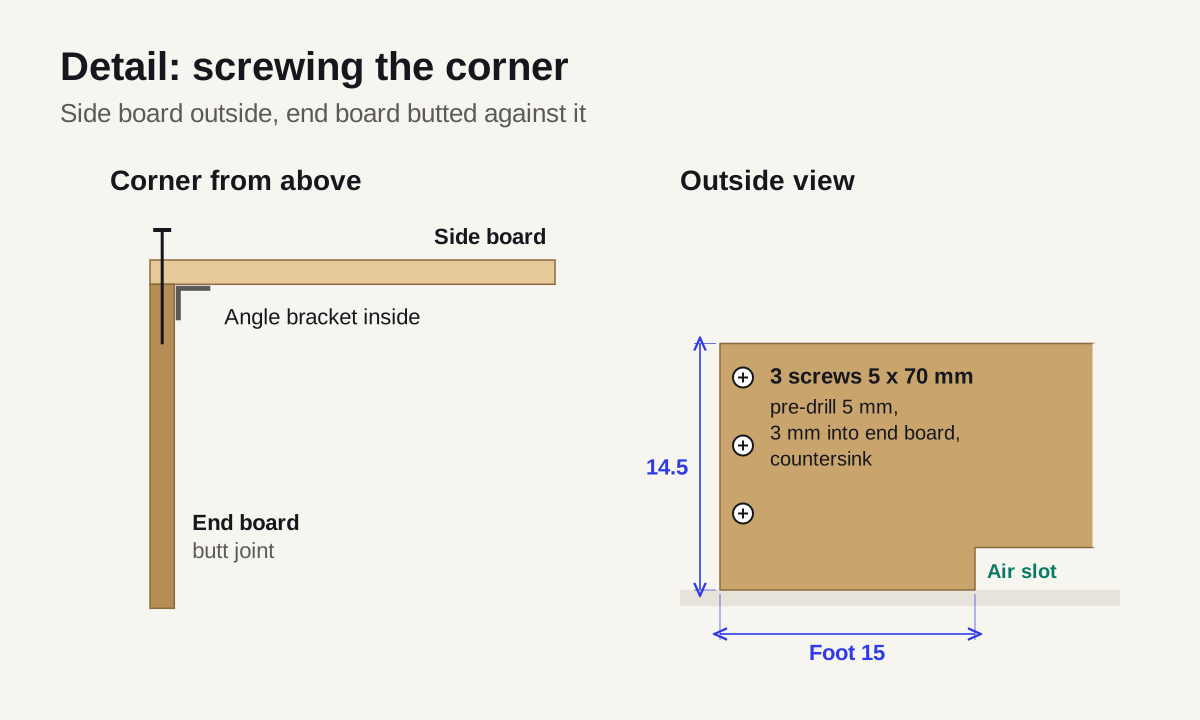
Stand the boards in a rectangle on a level floor. The side boards run through on the outside, the end boards butt against them. Hold each corner with a clamp. Drill three 5 mm holes through the side board at heights of 4.5, 8.5 and 12.5 cm, centred over the end board, and countersink them. Then pre-drill 3 mm into the end face of the end board and screw together with 5 x 70 mm screws.
Then measure both diagonals from outside corner to outside corner. At 147.4 x 208 cm each is about 255 cm. If both are the same length, the frame is square. Finally, fit an angle bracket inside each corner at the top.
Step 5: Felt pads and finish
Stick a felt pad under each foot to protect the floor. If you like, treat the wood with wood oil. Keep to the drying time on the packaging and only put in the underlay and mattress once the surface is completely dry.
Step 6: Lay in Matnext Airflow
Put the frame in its place and clean the floor underneath. Lay Matnext Airflow, cut to the size of the mattress, flat inside the frame. If needed, the underlay can be trimmed with scissors, for example with the Matnext universal scissors.
Step 7: Put in the mattress
Lay the mattress on the underlay and centre it so that about 1 cm of clearance to the frame remains all round. Done.
Ventilation in the floor bed: Matnext Airflow as the base
In this plan, Matnext Airflow is more than an extra layer: the underlay is the bottom of the bed. Its three-dimensional polymer mesh forms a continuously airy layer under the mattress. Moisture from the night can pass into the underlay across the whole underside, travel sideways inside it and leave through the slots in the frame.
At the same time the underlay has an elastic, cushioning effect. It needs no maintenance and comes in the width and length you choose.
Which thickness suits your floor bed?
For the floor bed we recommend Matnext Airflow PLUS with 20 mm. It gives the most height and therefore the largest air space between floor and mattress. The slots in the frame are matched to this thickness.
| Version | Height | Weight | Colour | Feature |
|---|---|---|---|---|
| Matnext Airflow PLUS 20 mm | approx. 20 mm | approx. 800 g/m² | white | extra height |
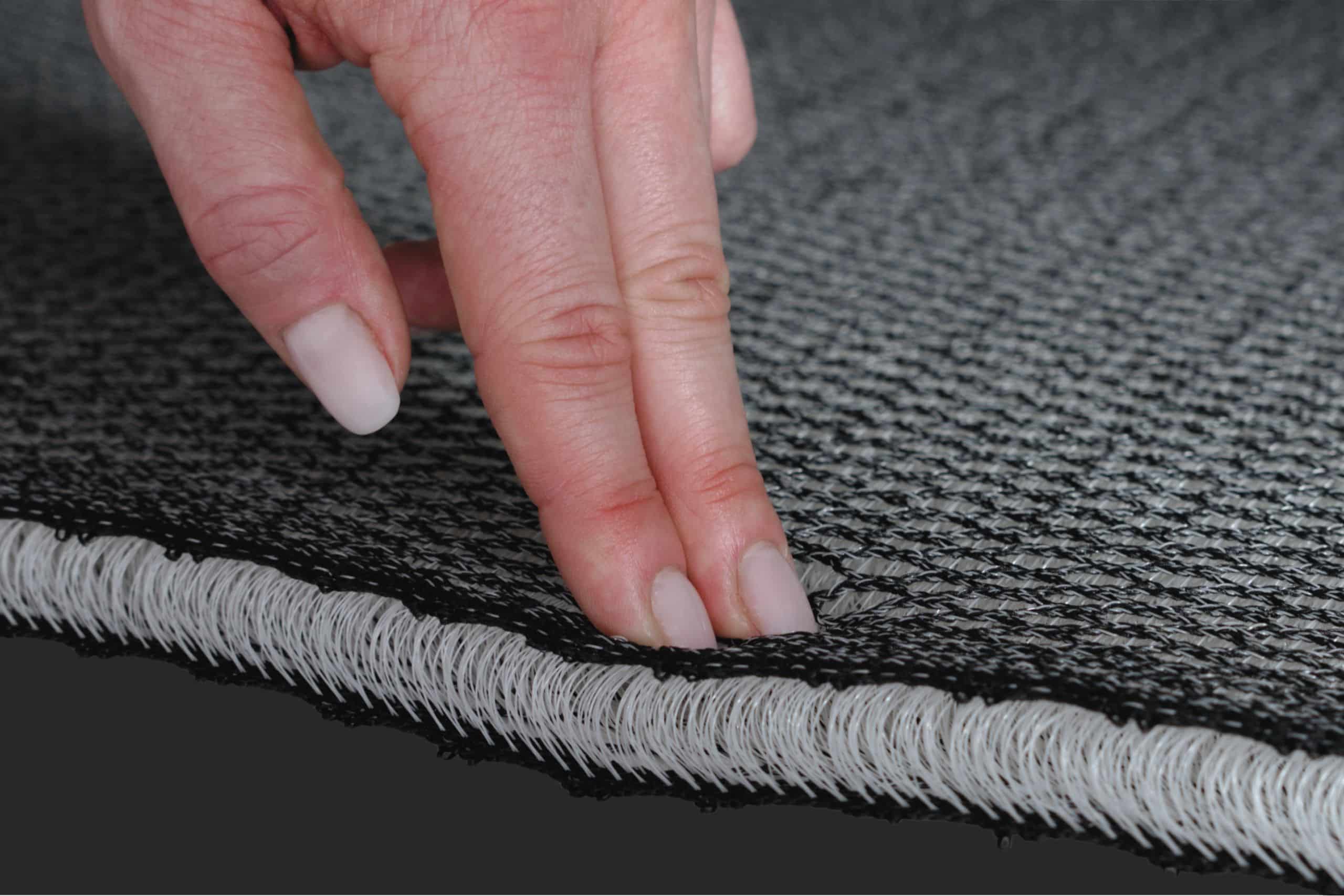
| Matnext Airflow BALANCE 15 mm | approx. 15 mm | approx. 600 g/m² | anthracite look | the all-rounder |
| Matnext Airflow 10 mm | approx. 10 mm | approx. 410 g/m² | white | ultra-light |
All three versions are made of 100% polyester, PLUS and BALANCE of which 70% recycled. You can choose width and length.
How the floor bed stays dry for good
- Keep the slots free: do not push the bed so close to the wall that the slots are covered. A few centimetres of distance are enough. This applies especially to cold outside walls.
- Fold back the duvet in the morning: this lets the mattress air out upwards after the night as well.
- Air the room regularly: opening the windows wide for a few minutes several times a day removes moisture from the room. How this works in everyday life is explained in our guide Properly ventilate and heat.
- Stand the mattress up now and then: check the underside, the underlay and the floor. If something has become damp after all, our guide Drying a damp mattress helps.
- Put nothing in front of the slots: boxes or blankets right against the frame slow down the air.
Frequently asked questions about the floor bed
How do I build a floor bed myself?
You cut four boards to size, saw shallow air slots into the bottom and screw the boards together into a frame. Matnext Airflow goes inside the frame and the mattress on top. The exact dimensions are in the material list, every step in the building instructions above.
Floor bed without slats: does that work?
Yes. In this plan Matnext Airflow replaces the slatted base. The underlay needs a flat, continuous surface: on slats it would press into the gaps. That is why it lies directly on the floor and itself makes sure the mattress gets air from below.
What do I put under a mattress on the floor?
An underlay that creates an air space under the mattress, for example Matnext Airflow. With or without a frame, the underlay lies flat on the floor and the mattress on top. This lets moisture escape from the underside instead of building up. More on this in our guide Put the mattress on the floor?
Can I put the mattress directly on the floor?
You can, but then there is no air space underneath. Moisture from the night stays on the underside and can lead to mildew stains and mould. If you do not want to build a frame, at least put Matnext Airflow underneath. More on this in our guide Put the mattress on the floor?
Can I put a slatted base directly on the floor?
You can, a slatted base on the floor raises the mattress a little. But Matnext Airflow does not belong on the slats, because the underlay would press into the gaps. That is why this plan does without slats altogether: Matnext Airflow lies directly on the floor.
Which mattress is suitable for a floor bed?
Any mattress that the manufacturer allows on a firm, flat base. Some manufacturers require a slatted base, you will find this in the details of the mattress. For the frame only the size counts: it is built to fit the mattress, and the table above shows the dimensions for the common sizes.
Floor bed and mould: what should I look out for?
Mould develops when the underside of the mattress stays damp for a long time. In the floor bed two things prevent this: Matnext Airflow as an air layer under the mattress and air slots in the frame that are kept free. If the mattress is already damp underneath, let it dry thoroughly first. How to recognise mould and what helps with a damp mattress is explained in our guide Prevent mould on the mattress.
How high is the floor bed?
The frame is 14.5 cm high. The mattress lies on the underlay, about 2 cm above the floor, and depending on its height sticks out above the frame. If you want the frame lower or higher, use narrower or wider boards. The slots stay 2.5 cm high.
Which wood is suitable for the frame?
Laminated panels or planed boards of spruce or pine are inexpensive, light and available in every DIY store. Make sure the wood is dry, straight and free of cracks. Harder wood such as beech also works, but is heavier and more expensive.
Can I cut Matnext Airflow to size myself?
Yes. Cut-outs and trimming can be done with scissors, for example with the Matnext universal scissors. For unusual sizes the underlay is also available as a custom size.
Does the underlay slip in the frame?
The frame holds the underlay in place on all four sides. If you want to fix it in addition, you can use the Matnext anti-slip clips: they stick to any smooth surface, and you pull the underlay over the studs with a little pressure.
Can I take the floor bed apart again?
Yes. Since everything is only screwed and not glued, you simply undo the screws and brackets when you move and transport the four boards separately.
The base for your floor bed
Matnext Airflow comes in 10, 15 and 20 mm, in your width and length or as a custom size.