

Dehumidifier for motorhome and caravan
Granules, 12 volt or compressor: which dehumidifier really helps in a camper and where it reaches its limits.
Dehumidifier in a motorhome: yes or no?
In short: Yes, if the vehicle is closed up, for example in winter storage. If you sleep, cook and shower in the motorhome, however, you put more moisture into the air than a small dehumidifier can absorb. On the road, airing and heating come first, and a dehumidifier is only a supplement.
Which dehumidifier for what?
- Winter storage without power: a dehumidifier with granules, checked every few weeks.
- Winter storage with hook-up: an electric dehumidifier. In cold air a desiccant unit works better than one with a compressor.
- On the road: air the vehicle thoroughly several times a day and heat it evenly.
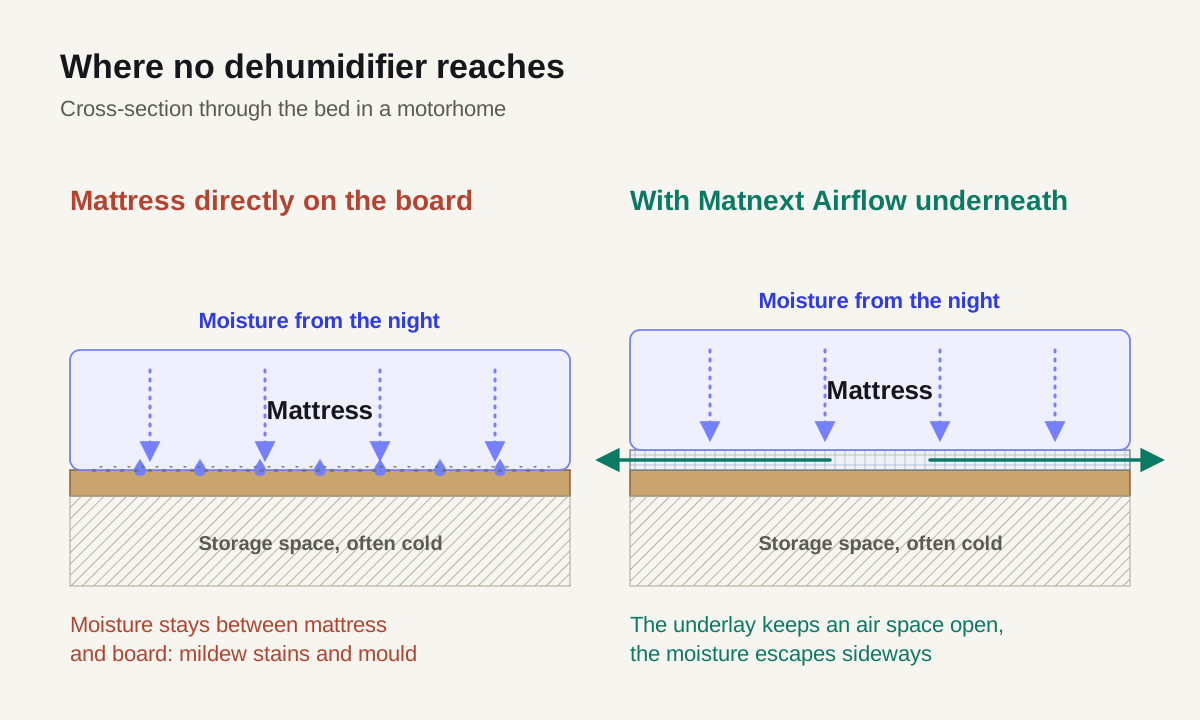
- Under the mattress: no dehumidifier reaches this spot. Here an underlay helps that creates an air space under the mattress, such as Matnext Airflow.
- Granules: no power needed, good for storage and cupboards
- Peltier with 12 volt: quiet, but little output
- Compressor: powerful, but only in warm air
- Desiccant: works in the cold too, uses more power
- Under the mattress only air from below helps
Why do motorhomes and caravans get so damp?
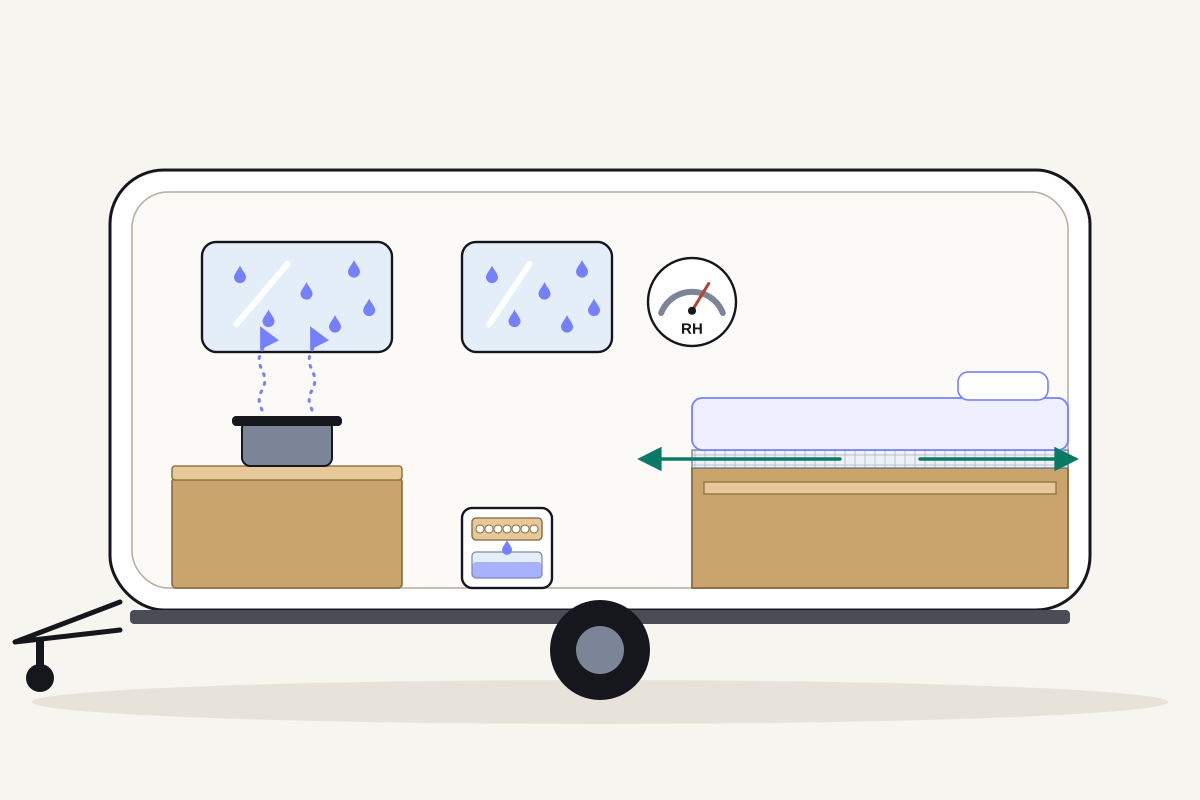
A camper has little air for a lot of everyday life. Every person gives off water vapour when breathing and sweating. The German Environment Agency (Umweltbundesamt) estimates 30 to 100 grams per hour and person, depending on activity. Add cooking, showering and wet jackets, and all of it spreads through just a few cubic metres of air.
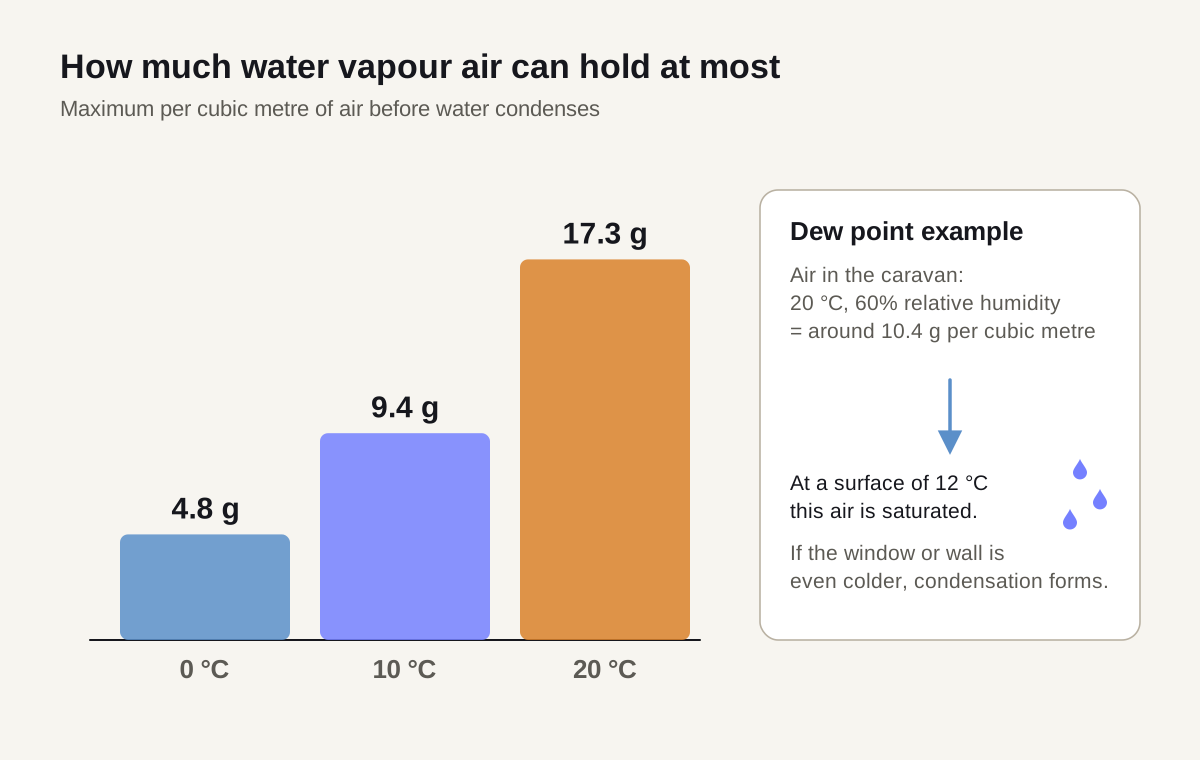
This moisture becomes a problem on cold surfaces. Warm air can carry much more water vapour than cold air. When it cools down on windows, outer walls or in the storage space under the bed, part of it turns into water. That is why the windows mist up first, and why it often feels clammy under the mattress.
Which dehumidifiers are there for motorhomes and caravans?
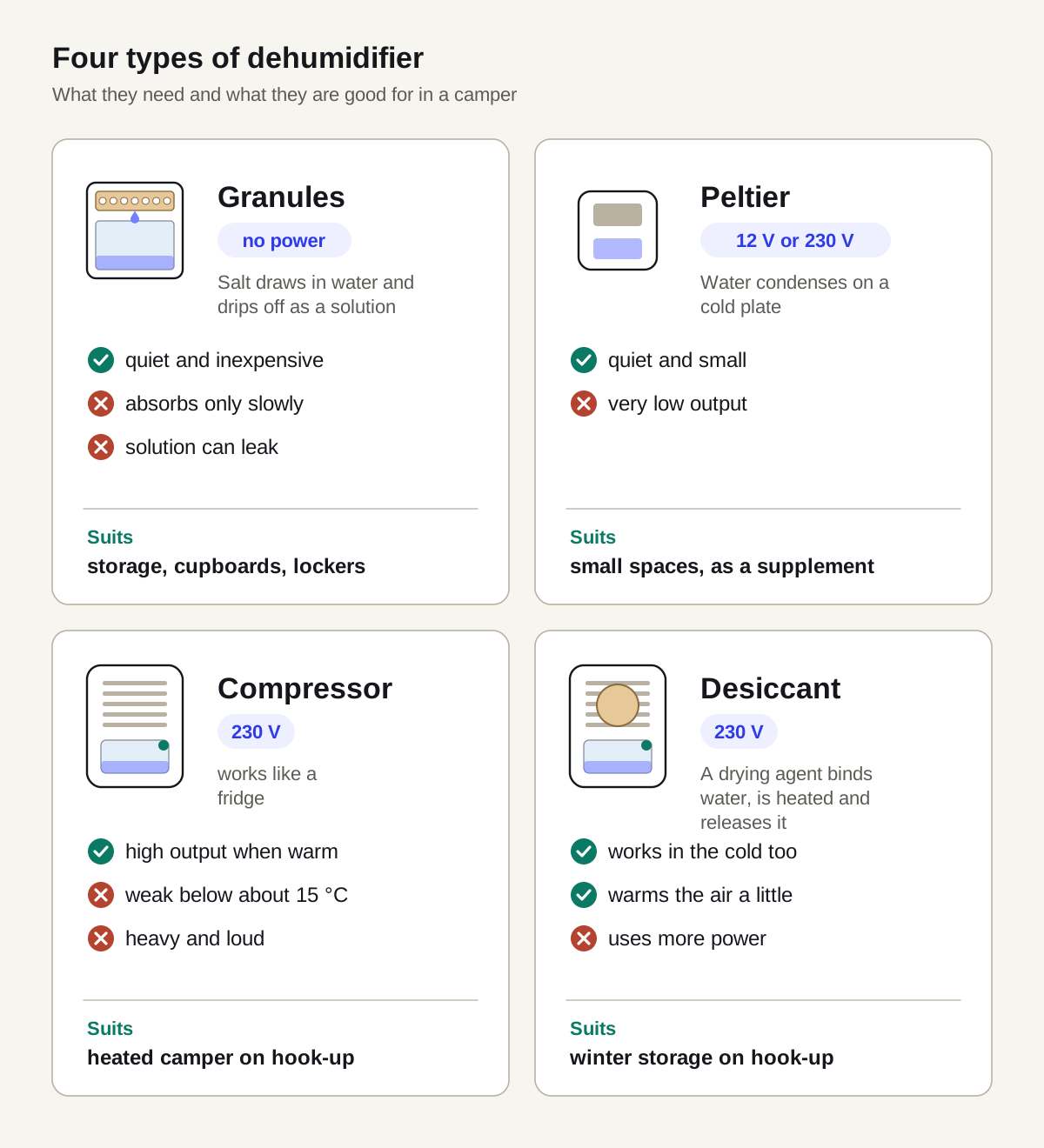
Four types are suitable for campers. They differ mainly in whether they need power and how well they work in cold air.
| Type | Power | Strengths | Weaknesses | Suits |
|---|---|---|---|---|
| Granules (calcium chloride) | none | quiet, inexpensive, runs unattended | absorbs slowly, granules must be refilled | storage periods, cupboards, lockers |
| Peltier (thermoelectric) | 12 V or 230 V, little | quiet, small, also on the leisure battery | very low output | small spaces, as a supplement |
| Compressor | 230 V | high output in warm air | much weaker in cold air, heavy, loud | heated camper on hook-up |
| Desiccant (adsorption) | 230 V, more than a compressor unit | works in cold air too, lighter and quieter | higher power consumption | winter storage with hook-up |
Compressor or desiccant in winter?
A compressor unit works like a fridge: it cools the air on a cold surface and the water drips into a tank. If the air is already cold, there is little room for that. According to the German sailing magazine Yacht, such condensation dryers only work really effectively down to about 15 degrees, and no longer at 5 degrees.
A desiccant unit binds the water to a drying agent and dries it out again with heat. It therefore also works in cold air, but uses more power. The air leaves the unit warmer than it came in, by about ten degrees according to Yacht. In unheated winter storage that is more of an advantage.
Dehumidifier without power: drying a caravan with salt
The simplest solution for storage periods is a dehumidifier with granules. The salt inside, usually calcium chloride, draws water from the air, slowly dissolves and drips as a salt solution into a collecting tray. It needs no power and works silently.
The downside: granules absorb only slowly. That is not enough for a camper you live in, but it works well for a closed vehicle, a cupboard or a locker. Depending on humidity, the granules need replacing about every one to three months.
- Place it safely: put the dehumidifier on a level surface, ideally in a tray. If the salt solution leaks, it leaves stains and can attack metal.
- Several small boxes instead of one big one: one in the living area, one in the bathroom, and if needed one in large lockers. The room size a unit covers is printed on the packaging.
- Check regularly: look at the fill level every few weeks. Once the container is full, the unit absorbs nothing more.
- Careful with the granules: they are very irritating to the eyes. Keep them away from children and pets. According to the manufacturers, the salt solution may go down the drain.
Household remedies such as cat litter or rice also absorb some moisture, but they saturate quickly and need frequent changing.
Electric dehumidifier in a motorhome: 12 volt, rechargeable or 230 volt?
12 volt: dehumidifiers for the leisure battery usually work with a Peltier element. They are quiet and small, but do little. In a comparison by the sailing magazine Yacht, an 18 watt unit removed only 250 millilitres from the air per day. Over weeks in winter storage they also drain the battery.
Rechargeable: small desiccant dehumidifiers absorb moisture until their indicator changes colour. Then they are dried out at a socket and are ready to use again. They suit cupboards and small compartments, not the whole living area.
230 volt: compressor or desiccant units do much more, but need hook-up. In winter storage, only drain the water through a hose into a drain if there is no risk of frost there. Many winter storage sites do not allow permanent power because of the fire risk. Ask the storage provider and your insurer beforehand.
Dehumidifying a caravan in winter: how to do it
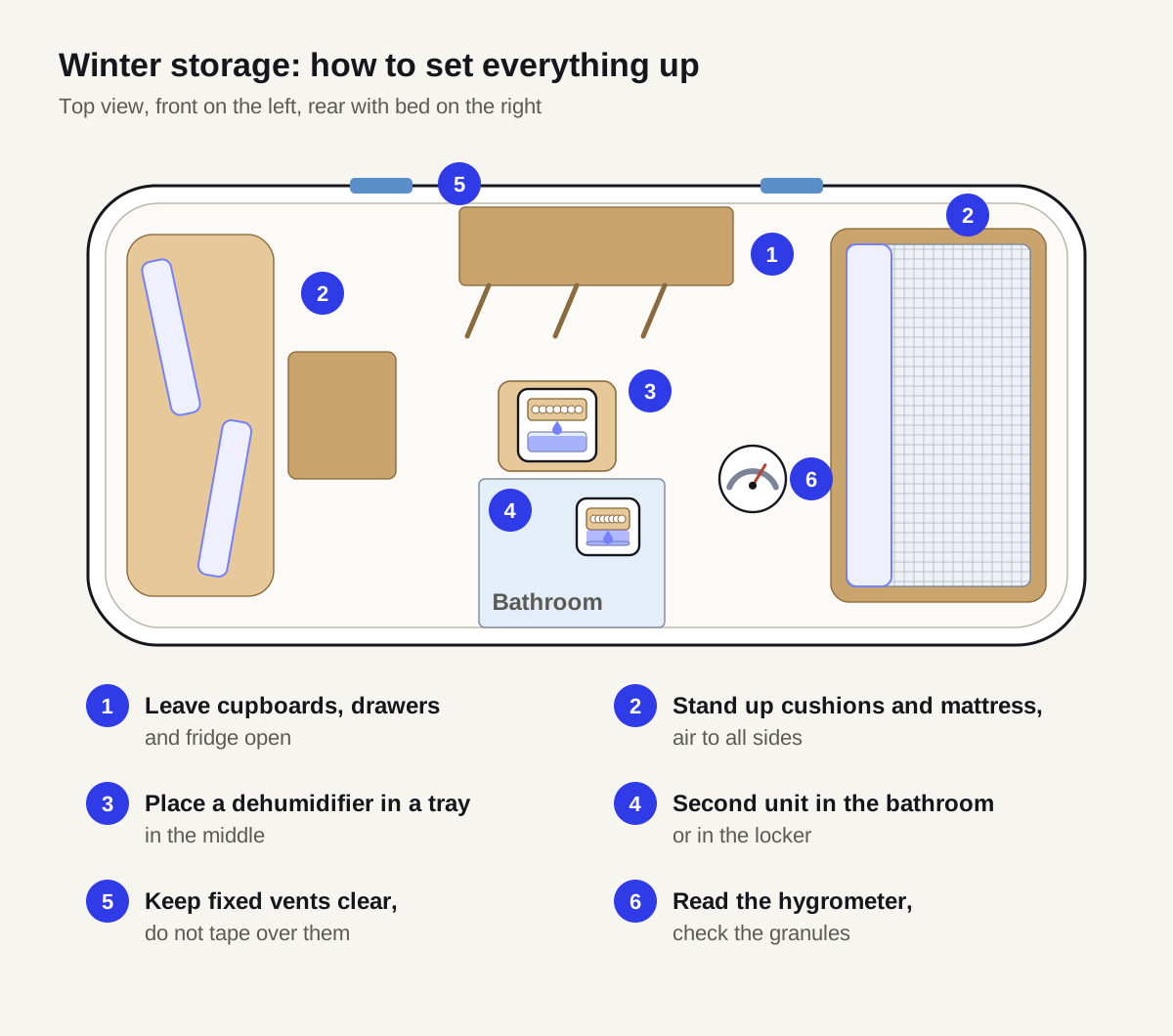
A dehumidifier only works as well as you prepare the vehicle. These steps have proven themselves for the winter break:
- Put it away dry: after the last trip, heat and air it thoroughly once more so that cushions and wood dry out. Wet textiles and food come out.
- Open everything: cupboards, drawers, fridge and bathroom door stay slightly open so that no air stands still.
- Stand up cushions and mattress: on edge or at an angle so that air reaches all sides, including the underside.
- Keep vents clear: do not tape over fixed ventilation, not even against the cold.
- Spread the dehumidifiers: one in the middle of the living area, one in the bathroom or the largest locker, each in a tray.
- Measure: put a hygrometer in the camper. The German Environment Agency (Umweltbundesamt) recommends that relative humidity indoors should not stay above 65 to 70 percent in the long run. If the value rises, air the vehicle on a dry day and refill the granules.
How to get the camper ready again in spring is explained in the guide bringing the motorhome out of hibernation.
What a dehumidifier cannot do: moisture under the mattress
A dehumidifier dries the air in the room. Under a mattress that lies flat on the board of a bed box or a converted seating area, however, the air hardly moves. At night, moisture from sleep travels downwards. When it meets the cool board, it can condense there. The dehumidifier in the room cannot reach this spot, even if the hygrometer shows good values.
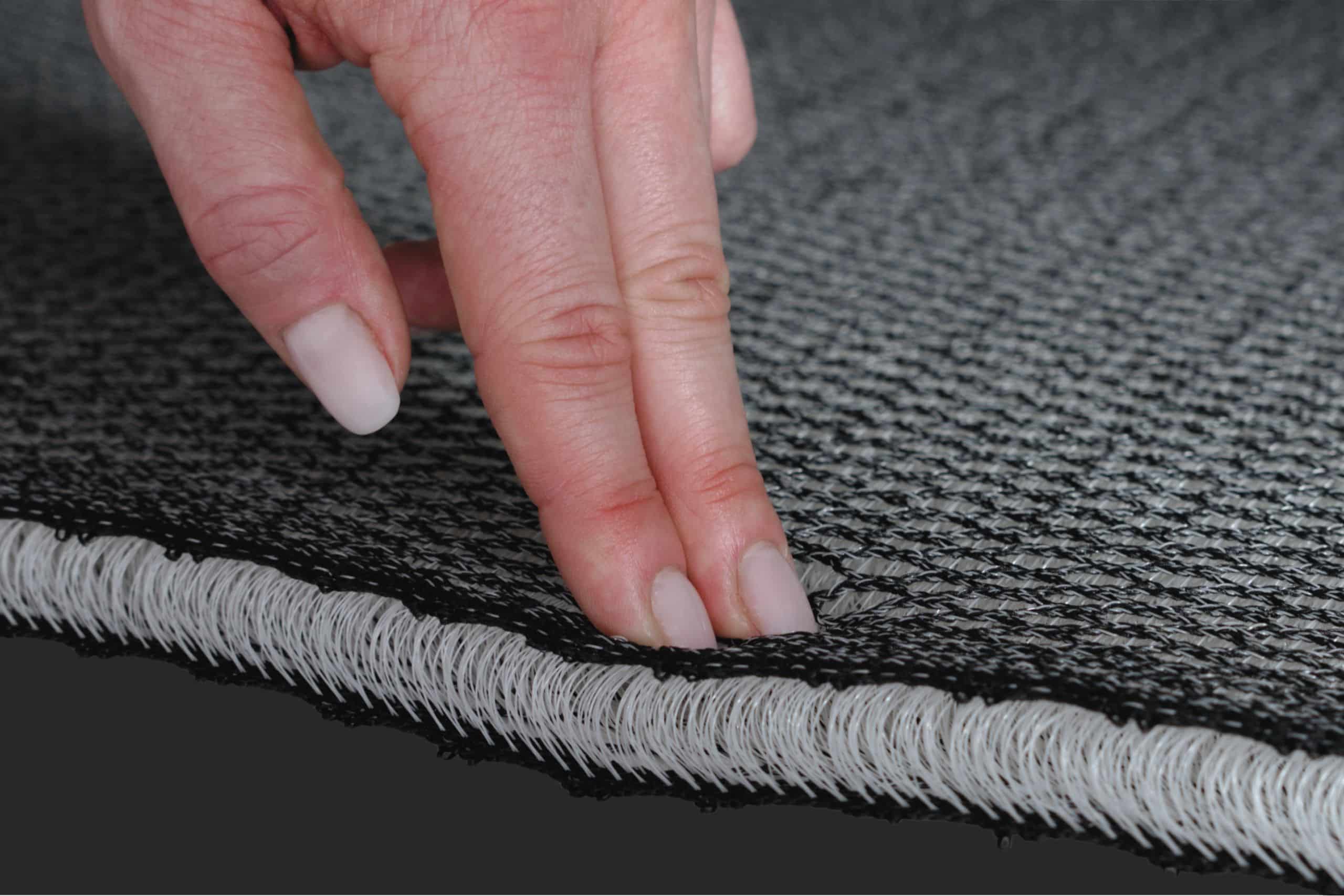
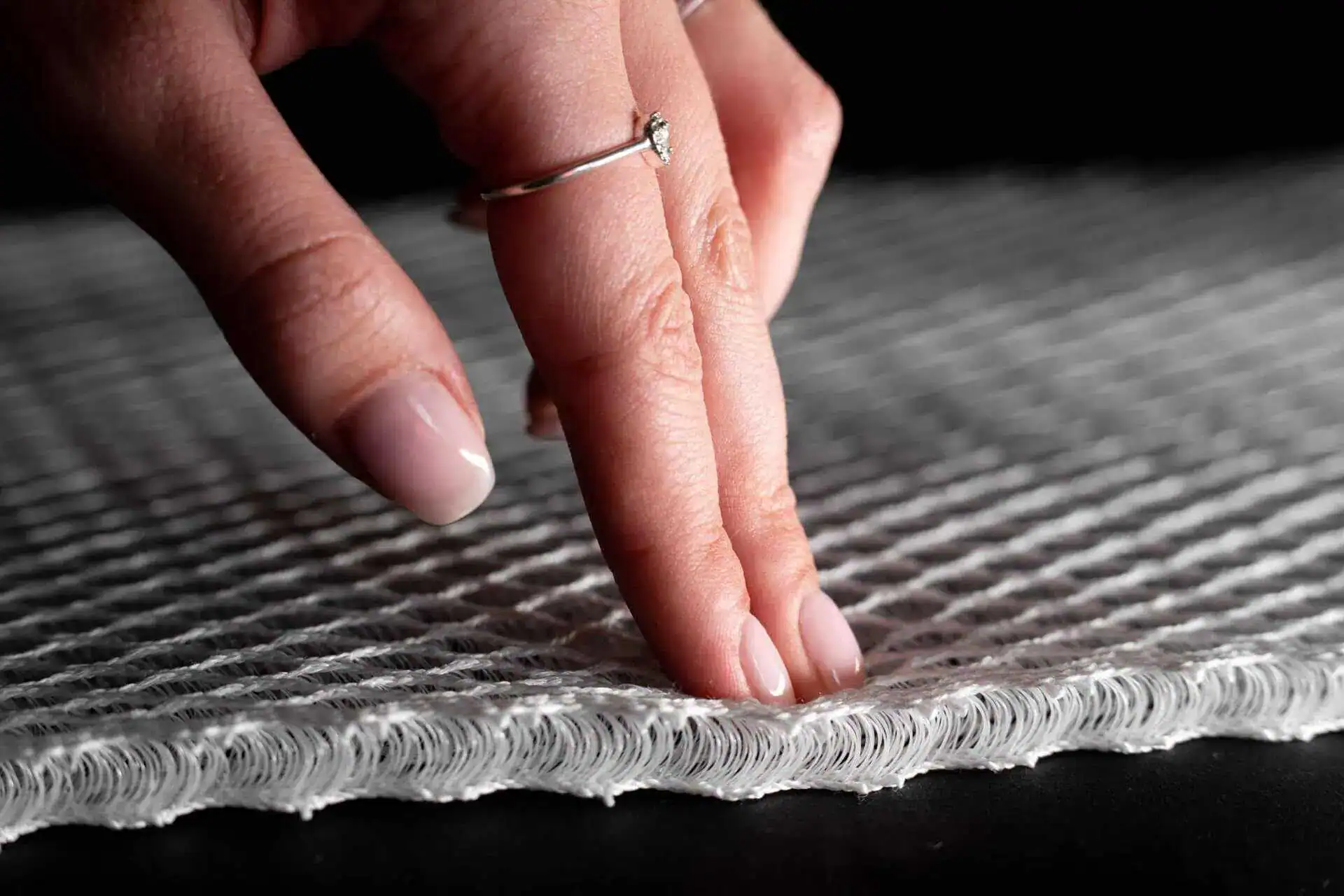
Only air from below helps here. Matnext Airflow is a 3D mesh underlay that lies between the mattress and the board. Its three-dimensional polymer mesh keeps an air space open in which the moisture under the mattress can escape. At the same time, the underlay cushions hard bed boards.
Which thickness suits a motorhome?
For motorhomes and caravans we usually recommend Matnext Airflow PLUS with 20 mm: it gives the largest air space and extra height on hard boards. If height is tight, for example under a drop-down bed, Matnext Airflow BALANCE with 15 mm fits, made of 70 % recycled material. Our underlays come in standard sizes and as a custom size, and you can cut them to angled corners with scissors.
More on condensation on windows, cushions and under the mattress is in the guide moisture in the camper. If mould is already there, the guide removing mould in the camper helps.
Frequently asked questions about dehumidifiers in campers
Is a dehumidifier in a motorhome worth it?
In a closed vehicle, yes, for example in winter storage or during a longer storage period. If you live in the motorhome, breathing, cooking and showering create more moisture than a small dehumidifier absorbs. Then airing it thoroughly and heating evenly matter more.
Which dehumidifier is best for a caravan?
That depends on whether there is power and how cold it gets. Without power, granules are the answer. With hook-up in cold winter storage, a desiccant unit works better than a compressor unit, which drops off clearly in cold air. In a heated camper, a compressor unit does a lot.
How often do I need to change the granules?
About every one to three months, depending on humidity. Check the fill level every few weeks: once the container is full, the unit absorbs no more water.
Is a 12 volt dehumidifier enough?
For a small area or as a supplement, yes. 12 volt units usually work with a Peltier element and do very little: in a comparison by the sailing magazine Yacht it was 250 millilitres a day. That is not enough for the whole vehicle.
Can I leave the dehumidifier running in winter storage?
A granule dehumidifier, yes, it needs no power. An electric unit only if permanent power is allowed. Many winter storage sites forbid it because of the fire risk. Ask the storage provider and your insurer beforehand.
Does a dehumidifier help against mould under the mattress?
Only a little. It dries the room air, but it does not get under a mattress that lies flat on a board. There, an underlay such as Matnext Airflow helps by creating an air space under the mattress.
Air under the mattress
Matnext Airflow comes in 10, 15 and 20 mm, in your width and length or as a custom size.